Waldorf News

The High Price of Materialism
April 30, 2012
Scientists have found that materialistic values and pro-social values are like a see-saw. As materialistic values go up, pro-social values tend to go down. This helps explain why people act in less empathic, generous and cooperative ways when money is on their minds. When people are under the sway of materialism, they also focus less on caring for the Earth. The same type of see-saw is at work here. As materialistic values go up, concern for nature tends to go down. Intrinsic values not only promote personal, social and ecological well-being, but can also act to immunize people against materialism. It's that see-saw again. As intrinsic values go up, materialism tends to go down. Build a life that expresses your intrinsic values. Spend more time with people you care about, finding meaningful work, volunteering for causes that you care about. But change in our lifestyles isn't enough. We also need to advocate for policies that promote intrinsic values. Recognize that well-being and a sense of community are necessary parts of policies that truly encourage intrinsic values. More »
A New Inspiration for Education: A report from the Western Waldorf Educators Conference featuring Aonghus Gordon
April 23, 2012
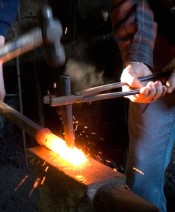
Working with teens and young adults with complex learning and behavioral difficulties, many of whom have autistic spectrum conditions, students have benefited from the practical skills therapeutic education. Mr. Gordon and the Educational Trust have discovered, through the learning of practical-craft skills, the engagement of will-intentions and movement-intentions facilitate well-being and social health. The transformation of matter requires sensory engagement and lawful movement, strengthening a relationship to the three planes of space, serving as a powerful aide toward incarnation. A new moral aesthetic emerges that inspires and awakens one’s self-worth and their relationship to the world. Our ability to consciously penetrate our dimensional existence with movement builds our ability to move through life. As Mr. Gordon expressed, “Meeting resistance in matter helps us move through our own inner resistance. The blacksmith hammers out his own stiffness. The carpenter smooths her own rough edges.” More »
Working with Parents: A Different Perspective
April 23, 2012
Are we open to new ideas? Are we open to other ways of doing things? Waldorf teachers are famous for believing that we are the ones who have found the truth and are doing the best work with children and we are very often disinterested in the work going on outside of the Waldorf movement. Can we develop interest in different ways of working? Can we truly say that we are free of prejudice? New manifestations of truth must find us ready at any time to receive them. Can we look beyond all the tattoos and piercings of a new parent or colleague and find the human being within? Can we accept a parent’s perspective and thoughts with the same enthusiasm as we carry our own? For those of us who have been in Waldorf Schools for a long time, can we accept what the younger generation of teachers brings to this work even when it is different from what we expected? Can we recognize the gifts each generation brings? How open are we to differences of opinion in our personal and professional lives? Are we so afraid of conflict that we become defensive or retreat? More »

Einstein May Never Have Used Flashcards, But He Probably Built Forts: Bringing play back into the lives of children
April 6, 2012
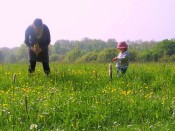
This focus on the physical goes back a long way. Author Susan Solomon, a contributor to Where Do the Children Play?, writes in American Playground that when freestanding playgrounds were first created in the late 1880s, one of the beliefs was that “physical activity, especially muscle control, had a moral dimension that would create better citizens.” Eventually playgrounds got dulled down even more as safety concerns grew. In 1999, 156,000 children were treated in hospital emergency rooms because of public playground-related injuries, according to the U.S. Consumer Product Safety Commission. Add to this a lawsuit-crazy culture and public playground design has become an exercise in restraint and caution. Goodenough says that in Ann Arbor, Mich., where she now lives, sledding was recently banned during recess after an elementary school student suffered a concussion. Concerns over bullying and the lack of personnel to supervise students have also prompted schools to put limitations on playground use. More »

Eugene Schwartz: Online Teacher Training, The Challenges of China and Anthroposophy for Teachers
April 5, 2012
From the moment I began recording my lectures in the 1980s I was told that “Neither Anthroposophy nor Waldorf education can be disseminated without the live presence of a human being standing before you.” We must realize, however, that the people who tend to say that sort of thing were not on earth when Rudolf Steiner was a “live presence.” They learned about Anthroposophy from Rudolf Steiner’s books. And Steiner was clear that it is possible for a spiritual teacher in our time to be embodied in a book, so that he becomes “mobile” and people can encounter him or her in freedom and when the time is ripe. Most Waldorf teachers under age 30 have no problem with online learning, and I am interested in how many teachers in their 50s tell me that the most exciting thing about my online conference is that it helped them overcome their fear of computers and the Internet. It is likely that within the next decades far more people will encounter Anthroposophy through the radiant light of computer screens and devices rather than via the reflected light of the page of a book. More »
 Recent Jobs
View more jobs »
 Newsletter Archive
 Join the Mailing List!
Stay Connected…
Each week receive the Waldorf News Weekly Update, full of news, events, and more. Keep abreast of what's happening with Waldorf education.
 Add a Job Listing


 RSS Feeds