Waldorf News

Saint Michael in the Midst of Everyday Life: Conversation with Waldorf teacher Gudrun Koller
June 4, 2012
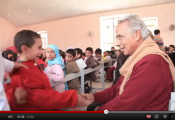
To learn about Michael’s fight with the dragon it is sufficient to just awaken every day and meet life openly. There are, however, people who experience this fight in a very intense way because they are in life situations that exist outside of the well-ordered and secure normal daily course of events. They are confronted with exigencies and abysses that other people only experience through literature and the media. There are such people in every country. In my country of Switzerland, in the midst of the prosperous paradise of Zurich, you have only to leave the familiar downtown plaza, ride ten minutes in a streetcar away from the bank district and railroad station – and you find yourself in a completely different world! For instance, you will encounter a schoolhouse with 350 children, almost all of them foreign-born. In this educational milieu more than 90 different languages are being spoken. The children come from a vast number of countries and cultures in the world. Here, Waldorf teacher Gudrun Koller has been doing impressive work for many years. Waldorf pedagogical practices, combined with devoted human involvement and openness to the spirit, are united with the concrete practicalities of life. This woman lives day by day, without fanfare, putting anthroposophical work ethics into practice. All of us have the repeated opportunity to meet something new in our habitual circle; we are all occasionally confronted with a human crisis that can be met with compassion and deeds. The question is: do we heed the “call of Michael,” the summons to engage our own deeds to meet the needs of our fellow human beings? More »
Sekem: A flourishing community in Egypt
May 29, 2012
SEKEM, founded thirty-five years ago northeast of Cairo, embodies sustainable development in the fields of economy, science and technology, culture and spirituality, and society and nature. Their goals are to restore and maintain the vitality of the soil and food as well as the biodiversity of nature through biodynamic agriculture and to support social and cultural development in Egypt. SEKEM, whose name comes from the Ancient Egyptian hieroglyph and means “vitality from the sun” was founded in 1977 by the Egyptian pharmacologist and social entrepreneur Dr. Ibrahim Abouleish in order to bring about cultural renewal in Egypt on a sustainable basis. More »

Puberty Before Age Ten: A New 'Normal'?
May 21, 2012
One day last year when her daughter, Ainsley, was 9, Tracee Sioux pulled her out of her elementary school in Fort Collins, Colo., and drove her an hour south, to Longmont, in hopes of finding a satisfying reason that Ainsley began growing pubic hair at age 6. Ainsley was the tallest child in her third-grade class. She had a thick, enviable blond-streaked ponytail and big feet, like a puppy’s. The curves of her Levi’s matched her mother’s. “How was your day?” Tracee asked Ainsley as she climbed in the car. “Pretty good.” “What did you do at a recess?” “I played on the slide with my friends.” In the back seat, Ainsley wiggled out of her pink parka and looked in her backpack for her Harry Potter book. Over the past three years, Tracee — pretty and well-put-together, wearing a burnt orange blouse that matched her necklace and her bag — had taken Ainsley to see several doctors. They ordered blood tests and bone-age X-rays and turned up nothing unusual. “The doctors always come back with these blank looks on their faces, and then they start redefining what normal is,” Tracee said as we drove down Interstate 25, a ribbon of asphalt that runs close to where the Great Plains bump up against the Rockies. “And I always just sit there thinking, What are you talking about, normal? More »

High-tech vs. no-tech: D.C. area schools take opposite approaches to education
May 14, 2012
The Flint Hill School in Oakton is ultra-wired. Apple hails it as a model for its embrace of devices. Teachers here believe technology immersion will make their students more excited about learning and better prepared for college and careers. So they’ve given each child a device — starting with an iPad for every preschooler and MacBook Airs starting in the fifth grade. “Tech is like oxygen,” said Shannan Schuster, Flint Hill’s dean of faculty. “It’s all around us, so why wouldn’t we try to get our children started early?” The Washington Waldorf School in Bethesda is trying its best to stay unplugged. Its teachers think technology is a distraction and overhyped. They believe children are better taught through real-world experiences in the school’s vegetable garden and woodwork shop. Educators here fear that the immediate gratification of texts and Wikipedia threatens face-to-face communication and original thinking, so they ban cellphones, laptops and tablets and require students to hand-write papers until high school. “What is the rush?” said Natalie Adams, Washington Waldorf’s faculty chair. “There is a time and a place for technology, but children need to first relate to the physical world around them.” More »

The Waldorf Teacher: Someone You Can Steal Horses With
May 7, 2012
Quite often the people with the least academic proficiency are the least damaged in their will forces, in their ability to take initiative and to act in the world. They never had the patience to learn about the world at one or two or three removes, but they were in the world as mechanics, social workers, nannies, forest rangers, fire fighters and the like. Such people often have the most potential to become wonderful teachers. Children know when they are looking at people who can manage in the world. Children know who’s reliable, whether a teacher is someone they can “steal horses with” as the proverb has it. If teacher training students have a bit of rascal in themselves, they have mustered the first pre-requisite for Waldorf teaching: not to be a pedant. More »
 Recent Jobs
View more jobs »
 Newsletter Archive
 Join the Mailing List!
Stay Connected…
Each week receive the Waldorf News Weekly Update, full of news, events, and more. Keep abreast of what's happening with Waldorf education.
 Add a Job Listing


 RSS Feeds