Waldorf News
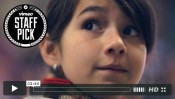
Shelter from the Storm: A Brief Refuge in East Los Angeles
December 10, 2012
"Unless we do something with education with the total human being, we are not really preparing our children. That sense of security is so incredibly powerful for kids. So many of our children don't feel safe at home, or in their neighborhoods, so to feel safe in school is so beautiful. To know that they won't be put down or hurt, this is my dream that we do this. Can you imagine if all schools would feel this way?" -Mrs. Reifler More »
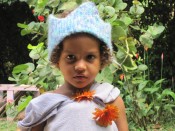
A View from the Tropics: The Sea Heart School in Costa Rica
November 4, 2012
A tropical Waldorf kindergarten setting differs in more than just the ambient noise, though that in itself can be significant. The constant sounds of the ocean, birds, insects, animals and wind in the trees are an ever-present reminder of the life and movement which surrounds us. Nothing stops here. Growth is year round and abundant: the etheric forces are incredibly strong. Leave prunings on the ground and they will sprout, or become a quick home to a colony of termites and a small mushroom farm. Compost piles are ready in a month. Life and death are ever present and it’s not unusual for the smell of death to waft through the gardens or classrooms: the children scan the skies for vultures when their noses pick up the familiar scent. The deep greens of the jungle, the red and orange blaze of the native flowers and the bright blue of the sky and sea are all intensified by the hot glare of the tropical sun; in the rainy seasons the force and energy of the downpours can wash away bridges, trees, beach and roads. The children are all the time bathed in these thick environmental etheric forces. More »

Our Hands Belong to Levity
October 19, 2012
Part of my work as a Waldorf educational support teacher is assessing school-age children, either whole classes as part of a class screening or individual children who are having difficulties in school. I find that many of these students’ grasp on the pencil is tense and/or awkward. Then I ask them to do various fine motor activities and notice difficulties with finger differentiation; it’s as if several or all of the fingers work as a unit rather than as separate fingers—which would be more efficient and less tiring. This may sound surprising as students in a Waldorf school do so many activities that involve the hands, from playing the flute or recorder to drawing, knitting and sewing. However, if you look at how these children engage their hands in these activities you can see either a lot of tension or quite loose and almost floppy work. When they draw figures of people they often leave out the hands as if they aren’t quite sure that the hands live at the end of the arms. More »
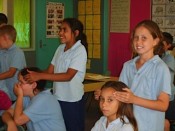
From Bullying to Belonging: How peer massage relieves social stress
October 15, 2012
We humans are essentially social beings. We yearn to belong, to be accepted; our brains are hard-wired to seek out connection and collaboration with other sentient beings for our very survival. In fact, in some cases, exclusion from one’s group will result in death. That’s why solitary confinement is the greatest punishment, short of death. Now, there are many ways to achieve connection, but touch, being our first sense to develop, is our primary language of acceptance and belonging, safety and security. Kind words and gestures are very effective in making someone feel welcome, but giving someone’s hand a squeeze or putting your arm around their shoulder confers a kinship and the relief of belonging like nothing else can. More »
Your Computer Doesn't Have Developmental Stages
October 15, 2012
Some of you may have caught this video when it first came around months ago. It’s a video of a baby trying ‘use’ a magazine as an ipad. The baby’s experience has been, simply put, ‘I do this, and this happens’. She expects the same experience with a magazine that she gets with the ipad: I swipe, it moves. If you were to search around the internet using the phrase ‘baby uses magazine as an ipad’, you would find quite a few blog entries discussing this video. They range from judgemental, to excitement about a young child using technology, to the opinion that this is a normal response for a young child, and not ‘ipad enduced’. So what thoughts do you have when you watch the video? You may find it hard to watch without judgement. Or not. You may start having a little internal argument with yourself, or with this child’s parents. Or, you may have negative thoughts about this youngster thumbing through Marie Claire magazine at her age. Whatever your reaction, it is very likely a conversation starter of some sort. What’s great about that is it opens the door for some exploration of technology/media and age-appropriateness. If you have a student in a Waldorf school, you’ve heard about technology and media use guidelines for students, and maybe you’re about to click out of this post. Over the past five years, the technology scene has changed rapidly as smart phones proliferate and ipads abound. It’s not just a game of minesweeper on your flip phone, it’s Angry Birds, complete with a marketing plan that includes stuffed characters available in stores. Is it ‘bad’? No. But in a Waldorf school, we can sometimes give and get the message that all technology is evil to be avoided. It used to be referred to primarily as ‘media’, and that meant movies, tv, and computer use. We can’t really call it ‘media’ these days, and I question whether we need to define ‘it’. I think a more complete approach is to focus on how children and their brains and bodies grow and develop and why certain activities are good for them at different stages. To do that, we as parents have to commit to informing ourselves about child development. More »
 Recent Jobs
View more jobs »
 Newsletter Archive
 Join the Mailing List!
Stay Connected…
Each week receive the Waldorf News Weekly Update, full of news, events, and more. Keep abreast of what's happening with Waldorf education.
 Add a Job Listing


 RSS Feeds