Waldorf News

Busy Hands, Busy Brains: Research shows that the most accomplished scientists are likely to be craftspeople
November 29, 2014
As a graduate student in the history of science at Princeton in the 1970s, Robert Root-Bernstein was struck by this common trait of great scientists: They all had many hobbies and interests, and practiced some form of art or craft. Later, as a post-doctoral fellow at the Salk Institute in the 1980s, he saw the same characteristic in a number of multitalented Nobel Laureates whom he got to know personally – people such as biochemist Robert W. Holley, who sculpted figures in bronze, and Roger Guillemin, a pioneer of electronic painting as well as brain hormone research. Today Root-Bernstein is himself a distinguished scientist, renowned for his research in biochemistry and autoimmune diseases, and one of the first recipients of the MacArthur Fellowship, known as the “genius grant.” He’s also a visual artist who believes that art and science come from the same creative place. More »

Inside the Box: People don’t actually like creativity
November 15, 2014
In the United States we are raised to appreciate the accomplishments of inventors and thinkers—creative people whose ideas have transformed our world. We celebrate the famously imaginative, the greatest artists and innovators from Van Gogh to Steve Jobs. Viewing the world creatively is supposed to be an asset, even a virtue. Online job boards burst with ads recruiting “idea people” and “out of the box” thinkers. We are taught that our own creativity will be celebrated as well, and that if we have good ideas, we will succeed. It’s all a lie. This is the thing about creativity that is rarely acknowledged: Most people don’t actually like it. Studies confirm what many creative people have suspected all along: People are biased against creative thinking, despite all of their insistence otherwise. More »

12 Ways Parents Can Protect Their Kids From Too Many Pills: Beware of pill pushing by drug companies and doctors
October 29, 2014
We are turning our kids into pill poppers. The rate of ADHD has tripled in just 20 years - it is now diagnosed in 11 percent of all children aged four to 17 and is medicated in six percent of them. And the percentages get really crazy for teenage boys- 20 pecent are diagnosed and 10 percent are medicated. There is also compelling evidence that most of this "ADHD" comes from careless diagnosis. How else to explain that a child's date of birth is the best predictor of whether he gets the label- the youngest kid in the class is almost twice as likely as the oldest to be diagnosed with ADHD. Misplaced diagnostic exuberance has turned age-appropriate immaturity into a psychiatric disease and treats it with a pill, rather than just letting the kid grow up. The drug companies are delighted. Their annual revenue from ADHD drugs has exploded- it is now 50 times greater than 20 years ago, up to almost $10 billion a year. Wouldn't most of this money be better spent not on pills but rather to reduce class sizes and provide more gym periods so that fidgety kids could blow off steam? More »

Is Google Making Students Stupid? Outsourcing menial tasks to machines can seem liberating, but it may be robbing a whole generation of certain basic mental abilities
October 25, 2014
All of this has unmistakable implications for the use of technology in classrooms: When do technologies free students to think about more interesting and complex questions, and when do they erode the very cognitive capacities they are meant to enhance? The effect of ubiquitous spell check and AutoCorrect software is a revealing example. Psychologists studying the formation of memories have found that the act of generating a word in your mind strengthens your capacity to remember it. When a computer automatically corrects a spelling mistake or offers a drop-down menu of options, we’re no longer forced to generate the correct spelling in our minds. This might not seem very important. If writers don’t clutter their minds with often-bizarre English spelling conventions, this might give them more energy to consider interesting questions of style and structure. But the process of word generation is not just supplementing spelling skills; it’s also eroding them. When students find themselves without automated spelling assistance, they don’t face the prospect of freezing to death, as the Inuits did when their GPS malfunctioned, but they’re more likely to make errors. More »
"Siri, What Is an Ear Infection?"
September 9, 2014
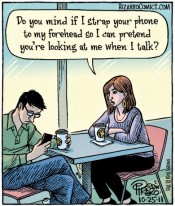
I’ve been a pediatrician for 20 years, and I thought I’d seen it all. But not long ago when a father brought his 2-year-old into my clinic, something happened that has me deeply concerned. Upon entering my examining room, I found father and son sitting together, eyes downcast, each silently scrolling and tapping on smartphones. During my initial exam, the father directed most of my questions to his frowning toddler, who indicated that his ears hurt, and I quickly discovered that both eardrums were red and inflamed. “Guess what?” I said to my small patient. “Your ears hurt because you have an ear infection. But we can give you medicine and make you better.” I smiled at the little boy and his father. Immediately, the child picked up his phone and pushed a button. “Siri,” he asked carefully. “What is an ear infection?” More »
 Recent Jobs
View more jobs »
 Newsletter Archive
 Join the Mailing List!
Stay Connected…
Each week receive the Waldorf News Weekly Update, full of news, events, and more. Keep abreast of what's happening with Waldorf education.
 Add a Job Listing


 RSS Feeds