Waldorf News

Benefits of a Biodynamic Education: Students at High Mowing School uncover more than just science lessons from horticulture study
February 8, 2016
Abbot Hill in Wilton, New Hampshire, is home to High Mowing School, a Waldorf boarding high school, and Temple-Wilton Community Farm, one of the first biodynamic community supported agriculture (CSA) programs in the U.S. Also nearby is the Yggdrasil Land Foundation, an agricultural land trust committed to protecting biodynamic farmland. The result of such close proximity has been an extraordinarily collaborative project between High Mowing, which purchased farmland adjacent to its campus, and Yggdrasil, which purchased the conservation easement rights. The protected land is now used by the school, and is also leased to Temple-Wilton to support its grazing and feed needs. In the midst of all this activity, Brad Miller, a biodynamic farmer turned teacher at High Mowing, developed an innovative horticulture program that engages students in the many facets of stewarding land while learning life lessons from it. Katrina Steffek, RSF’s chief operating officer, spoke with Mr. Miller about what his students gained in their study of diversified and balanced farm ecosystems. More »
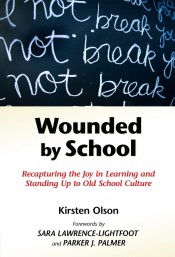
How Does School Wound? Kirsten Olson Has Counted Some Ways: Dr. Kirsten Olson’s interviews identified seven kinds of school wounds
February 1, 2016
Wounds of creativity: School stifles creativity. This is perhaps the most obvious wound of school. Students' own passions and interests are generally ignored. Students' unique, creative ways of solving problems and their outside-the-box answers to questions, which fail to match the teachers' answer sheets, are not understood and are graded as wrong by busy teachers. Rote learning and tests that have one right answer for every question leave no room for creativity. Olson's informants who went on to live creative lives apparently did so despite, not because of, schooling. They had to recover or rebuild the creative spirit that had been so natural to them before starting school. My own guess is that altogether too many others rarely think about creativity once they have lost it in school; they may not even notice this wound. And then there are those who remain creative in those realms that school doesn't touch, but become uncreative in the realms covered by the school curriculum. How many people have totally lost mathematical creativity because of the ways it was taught in school? More »
A different kind of eighth grade trip
January 26, 2016
Deer Hill Expeditions creates opportunities for meaningful 8th Grade class trips for Waldorf schools by facilitating real and genuine challenge in beautiful landscapes. Whether it’s the fun and adventure of a rafting expedition, or the uniqueness of an introduction to life in the Navajo Nation, or both, participants on Deer Hill programs have the chance to find their strengths in real experiences. Waldorf School of Orange County teacher, Miriam Whiteley, put it best in a letter to Deer Hill after an expedition designed for her 8th Grade class. More »

What one college discovered when it stopped accepting SAT/ACT scores
January 23, 2016
Hampshire College is a liberal arts school in Massachusetts that has decided not to accept SAT/ACT scores from applicants. That’s right — the college won’t accept them, a step beyond the hundreds of “test-optional” schools that leave it up to the applicant to decide whether to include them in their applications. So what has happened as a result of the decision? For one thing, U.S. News & World report has refused to include Hampshire in its annual rankings. For another, Hampshire officials say, this year’s freshman class, the first chosen under the new rules, is more qualified by other measures than earlier classes. Hampshire College was founded in 1970 as an alternative private liberal arts college that experiments with curriculum and relies on portfolios of work and narrative evaluations rather than distribution requirements and grades. It is one of the top colleges in the nation in terms of the proportion of its graduates who go on to graduate school. Here’s an explanation of what the college did regarding SAT/ACT scores and why, from President Jonathan Lash, who is also a director of the World Resources Institute, a D.C.-based environmental think tank, where he previously served as president. He chaired former President Bill Clinton’s Council on Sustainable Development and was Vermont’s environmental secretary and commissioner. He holds a law degree and master’s degree in education from Catholic University of America and a bachelor’s from Harvard College. More »

The message our children need to hear but almost never do
January 17, 2016
The rich middle- and high-school kids [Arizona State professor Suniya] Luthar and her collaborators have studied show higher rates of alcohol and drug abuse on average than poor kids, and much higher rates than the national norm.* They report clinically significant depression or anxiety or delinquent behaviors at a rate two to three times the national average. Starting in seventh grade, the rich cohort includes just as many kids who display troubling levels of delinquency as the poor cohort, although the rule-breaking takes different forms. The poor kids, for example, fight and carry weapons more frequently, which Luthar explains as possibly self-protective. The rich kids, meanwhile, report higher levels of lying, cheating, and theft. More »
 Recent Jobs
View more jobs »
 Newsletter Archive
 Join the Mailing List!
Stay Connected…
Each week receive the Waldorf News Weekly Update, full of news, events, and more. Keep abreast of what's happening with Waldorf education.
 Add a Job Listing


 RSS Feeds