Waldorf News

Screentime Is Making Kids Moody, Crazy and Lazy: Six Ways electronic screen time makes kids angry, depressed and unmotivated
March 21, 2016
Children or teens who are “revved up” and prone to rages or—alternatively—who are depressed and apathetic have become disturbingly commonplace. Chronically irritable children are often in a state of abnormally high arousal, and may seem “wired and tired.” That is, they’re agitated but exhausted. Because chronically high arousal levels impact memory and the ability to relate, these kids are also likely to struggle academically and socially. At some point, a child with these symptoms may be given a mental-health diagnosis such as major depression, bipolar disorder, or ADHD, and offered corresponding treatments, including therapy and medication. But often these treatments don’t work very well, and the downward spiral continues. More »

Working with the First Waldorf School in Madagascar
March 14, 2016
I recently returned from a 16 day visit to Madagascar where I was invited to work with the first school working out of Waldorf impulses on this island nation. It was a beautiful and transformative experience for the teachers there who have built this thriving school from the ground up and for me as well. More »
A Charter School’s Perspective
March 10, 2016
Is it possible for a public Waldorf charter school to reflect the same depth, joy, magic and artistic as well as academic excellence as a private Waldorf School? Can a public charter develop a classroom culture that is equal in its manifold layers to what we find in the private sector? Can public charter teachers take on the mantle of the Waldorf teacher with its demanding, yet rich inner life and equally demanding active outer life? Although many think that the jury is still out, those of us who work in these public charter schools would reply with a resounding Yes! Let’s take the case of Juniper Ridge Community School. Juniper Ridge is a K-8 charter school in its third year of operation. We are located in Grand Junction, a small town on the sparsely populated Western Slope of the Rocky Mountains. More »
How Children Play: Hasbro Asks a Waldorf Teacher
February 28, 2016
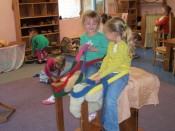
Hasbro is a leading global play products company based in Pawtucket, Rhode Island, with many well known brands, including Play–Doh, Transformers, Scrabble and My Little Pony. Most of us will remember games such as Monopoly and Candy Land from our own childhoods, but Hasbro has since added a new generation of electronic toys and digital gaming , and continues to look for new ways to play. Meadowbrook Waldorf School alumna Ceileidh Siegel is currently the company’s Director of Imbedded Innovation and leads a team working on design ideas intended for production 3-5 years from now. Ceileidh says her job is a mix of the Tom Hanks role in the movie Big, where a 12 year old wishes himself into an adult body then lands his dream job of professional toy tester, mixed with Shark Tank, the television show that ruthlessly investigates the viability of new product ideas. In 2015, Ceileidh’s team hosted a Hasbro "Summer Camp" focusing on the reinvention of two core brands. Her group worked with members of the company’s Marketing, Design, and Engineering, teams with the intention of providing timeless favorites, Baby Alive™ and FurReal Friends™, with a timely new twist. These lines feature play characters for young children that encourage patterns of role play and imagination. As a foundation for their work, Ceileidh felt that an in depth perspective on children’s innate need for play was essential for the group. She particularly wanted them to understand the importance of nurturing role play and what it brings to the developing child. Having experienced play–based Waldorf education at Meadowbrook from early childhood until graduating from grade 8 in 1997, she decided to invite MWS kindergarten teacher Su Rubinoffto share her expertise with the Hasbro group. Su has worked with children for more than 40 years and holds a Master of Science degree in remedial education. She has devoted many years to the study of child development, investigating the connection between sensory and academic learning. More »
Student flipping house for senior project
February 20, 2016
POTTSTOWN, PA--When Hannah Wolfram, a senior at Kimberton Waldorf School, was trying to come up with an idea upon which to base her senior project, she decided to defy expectation. "Anything performance-based was kind of what the expectation was," Wolfram said. "I decided I'd go out on a limb and do something I had never done before that was completely unexpected." A lover of the performing arts who enjoys contributing her singing and acting talents to the private school's theater productions, Wolfram decided she wanted to take on the challenge of flipping a house as the focus of her project. More »
 Recent Jobs
View more jobs »
 Newsletter Archive
 Join the Mailing List!
Stay Connected…
Each week receive the Waldorf News Weekly Update, full of news, events, and more. Keep abreast of what's happening with Waldorf education.
 Add a Job Listing


 RSS Feeds