Waldorf News

Emergency Pedagogy in Japan
July 31, 2013
After one of our therapeutic interventions and towards the end of a deep session in art therapy,one of the participants rose up with tears in her eyes; I had to wait to behold the moment. She then spoke out: that she had not ventured out of her house since that disastrous day and now she knew why it had to be now. “Before today I only experienced grey, but now for the first time since after the tsunami I can see and experience colour again,” she said. This was a moving moment. More »

Please Don't Help My Kids
July 22, 2013
Please do not lift my daughters to the top of the ladder, especially after you’ve just heard me tell them I wasn’t going to do it for them and encourage them to try it themselves. I am not sitting here, 15 whole feet away from my kids, because I am too lazy to get up. I am sitting here because I didn’t bring them to the park so they could learn how to manipulate others into doing the hard work for them. I brought them here so they could learn to do it themselves. They’re not here to be at the top of the ladder; they are here to learn to climb. If they can’t do it on their own, they will survive the disappointment. What’s more, they will have a goal and the incentive to work to achieve it. In the meantime, they can use the stairs. I want them to tire of their own limitations and decide to push past them and put in the effort to make that happen without any help from me. It is not my job — and it is certainly not yours — to prevent my children from feeling frustration, fear, or discomfort. If I do, I have robbed them of the opportunity to learn that those things are not the end of the world, and can be overcome or used to their advantage. If they get stuck, it is not my job to save them immediately. If I do, I have robbed them of the opportunity to learn to calm themselves, assess their situation, and try to problem solve their own way out of it. More »
Knitting Is More Important Than Homework
July 20, 2013
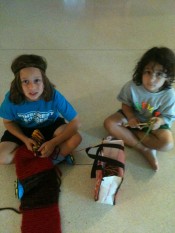
I toured the school and fell in love. So much so that, ironically, rather than celebrating a major find, in anger I called my mother to ask her why she didn’t send me to a Waldorf School. “Mom,” I spoke in my best moody tone, “why didn’t you find a school like this for me? Think of all the time I wasted learning how to forge your signature to get out of Physical Education!” I guess seeing this place made me realize how amazing school could have been. My brilliant, Ivy League-educated friend Lauren sent her children to Waldorf and because I am not good with details, she convinced me that the academics were totally fine. Listening to her well-articulated explanation of the school’s overall curriculum, I realized my kids would become more than just awesome knitters. Neal, and we, entered the Waldorf world. Without boring you with details about the Waldorf philosophy and its extension to our home life, I will tell you we limited all media to only minimal on the weekends, junk food is not permitted at school and they ask that kids don’t participate in competitive sports or overload on activities until they are older. More »

Student Science Experiment Finds Plants Won't Grow Near Wi-fi Router
July 19, 2013
Five ninth-grade young women from Denmark recently created a science experiment that is causing a stir in the scientific community. It started with an observation and a question. The girls noticed that if they slept with their mobile phones near their heads at night, they often had difficulty concentrating at school the next day. They wanted to test the effect of a cellphone's radiation on humans, but their school, Hjallerup School in Denmark, did not have the equipment to handle such an experiment. So the girls designed an experiment that would test the effect of cellphone radiation on a plant instead. The students placed six trays filled with Lepidium sativum, a type of garden cress, into a room without radiation, and six trays of the seeds into another room next to two routers that according to the girls' calculations, emitted about the same type of radiation as an ordinary cellphone. More »

Old-Fashioned Play Builds Serious Skills
July 15, 2013
On October 3, 1955, the Mickey Mouse Club debuted on television. As we all now know, the show quickly became a cultural icon, one of those phenomena that helped define an era. What is less remembered but equally, if not more, important, is that another transformative cultural event happened that day: The Mattel toy company began advertising a gun called the “Thunder Burp.” I know — who’s ever heard of the Thunder Burp? Well, no one. The reason the advertisement is significant is because it marked the first time that any toy company had attempted to peddle merchandise on television outside of the Christmas season. Until 1955, ad budgets at toy companies were minuscule, so the only time they could afford to hawk their wares on TV was during Christmas. But then came Mattel and the Thunder Burp, which, according to Howard Chudacoff, a cultural historian at Brown University, was a kind of historical watershed. Almost overnight, children’s play became focused, as never before, on things — the toys themselves. More »
 Recent Jobs
View more jobs »
 Newsletter Archive
 Join the Mailing List!
Stay Connected…
Each week receive the Waldorf News Weekly Update, full of news, events, and more. Keep abreast of what's happening with Waldorf education.
 Add a Job Listing


 RSS Feeds