Waldorf News

Is technology in schools making our kids smarter?
November 20, 2017
"Show me one study that shows a Chromebook in first grade, second grade, or third grade, leads to better educational outcomes in middle school or high school. There isn't any," says Dr. Kardaras. "I would think there are some benefits at the older ages. Kindergarten through elementary school I really see absolutely no benefit and actually quite a bit of clinical neurological damage.” "We know that neurologically there's been over 15 brain imaging studies that show that the frontal cortex, which is the executive functioning, actually atrophies and shrinks with exposure to screens in a similar way that it does with chronic substance addiction,” Dr. Kardaras continues. More »

'Our minds can be hijacked': the tech insiders who fear a smartphone dystopia
November 13, 2017
“One reason I think it is particularly important for us to talk about this now is that we may be the last generation that can remember life before,” Rosenstein says. It may or may not be relevant that Rosenstein, Pearlman and most of the tech insiders questioning today’s attention economy are in their 30s, members of the last generation that can remember a world in which telephones were plugged into walls. It is revealing that many of these younger technologists are weaning themselves off their own products, sending their children to elite Silicon Valley schools where iPhones, iPads and even laptops are banned. They appear to be abiding by a Biggie Smalls lyric from their own youth about the perils of dealing crack cocaine: never get high on your own supply. More »
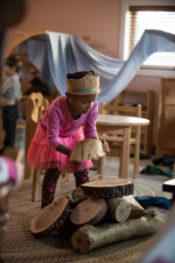
Four Unique Aspects of a Waldorf Kindergarten
November 6, 2017
Why does it feel so different, so special, in a Waldorf Kindergarten? There is a peaceful quiet under the hum of activity and focus, the teachers speak and sing softly and the children move about the room with a comfortable confidence at any given moment. There are many things that contribute to this unique setting, including the natural classroom design, the smell of fresh bread or soup, or the way the teachers move about the room doing purposeful work. There is also a deeper level of social, emotional and academic learning in the Waldorf Kindergarten that is a pervasive undercurrent in the daily rhythm of our early childhood classrooms. More »

'Western society is chronically sleep deprived': the importance of the body's clock
October 23, 2017
The cycle of day and night on our planet is age-old and inescapable, so the idea of an internal body clock might not sound that radical. In science, though, asking the questions “why?” and “how?” about the most day-to-day occurrences can require the greatest leaps of ingenuity and produce the most interesting answers. This was the case for three American biologists, Jeffrey Hall, Michael Rosbash and Michael Young, who earlier this week were awarded the Nobel in medicine or physiology, for their discovery of the master genes controlling the body’s circadian rhythms. The first hints of an internal clock came as early as the 18th century when the French scientist Jean-Jacques d’Ortous de Mairan noticed that plants kept at a steady temperature in a dark cupboard unexpectedly maintained their daily rhythm of opening and closing their leaves. However, De Mairan himself concluded this was because they could “sense the sun without ever seeing it”. More »

How do I Find and Create Goodness for My Children?
October 16, 2017
In difficult times such as these with environmental disaster of almost unprecedented scale and concern about friends and others in Japan at the forefront of our thoughts, it is not easy to feel the goodness in life. In an external crisis, our urge is often to listen and see the news and to share our feelings with other adults. As a consequence, it is easy for the children around us to be exposed to things that they cannot understand, to become fearful about situations they will never see and cannot change even if we think that the media or adult conversations are not attended to by the children. Even pre-verbal children can sense profoundly the distress in our inner being. But nothing brings stamina for life and daily well being to our children more directly and strongly than surrounding them and immersing them into an atmosphere of goodness and joy. For us as adults, the message they seek from us is this: I am happy to be alive, I am interested in the world around me and I want to find a place for myself within it. Children are born with an openness to meet what their lives will bring. Despite their individual destinies and challenges, this openness is present and as the adults in the child’s world, we have tremendous potential to cultivate this openness. More »
 Recent Jobs
View more jobs »
 Newsletter Archive
 Join the Mailing List!
Stay Connected…
Each week receive the Waldorf News Weekly Update, full of news, events, and more. Keep abreast of what's happening with Waldorf education.
 Add a Job Listing


 RSS Feeds