Waldorf News
Surviving to Thriving
October 14, 2025
Many teachers report that they experience situations that often wear them down and even “get under their skin.” Parents frequently report that they are exhausted. That they easily lose their patience. They feel “thin-skinned”, and even the smallest event can irritate them. Teaching and parenting bring a myriad of real-life challenges with them. There are ways, however, that we can create ever-widening safe spaces, around both the adult and the child, where we could learn, not merely to survive these encounters, but to move through them and thrive. Using rippling space and spatial buffers in the right way, what once may have been experienced as argumentative or aggressive behavior can become clearer, non-confrontational, and even more enjoyable. More »

The Youth Eurythmy Project
September 30, 2025
yep! offers young people from all over the world – between the ages of 18 and 25 – the opportunity to take part in a professional eurythmy stage production. A four-month rehearsal and training phase culminates in a major tour through the German-speaking region, across Europe, and possibly even another continent (the last yep project went to Brazil). You have questions about life, are open-minded, interested in art, love eurythmy, and enjoy moving! All your commitment, creativity, and joy of creation are dedicated to the common goal: to develop a young, existential eurythmy performance that we will bring to many venues. Experienced artists accompany the process. From the very beginning, you will be actively involved in the planning, conception, and implementation of costume design, masks, lighting design, and details of tour organization (such as press work, logistics, etc.) – in short, in the many different areas of such a project. Participation in yep! is free of charge. You only need to cover a one-time registration fee of €200, plus affordable accommodation and m More »

A Norwegian Approach to Supporting Children’s Risky Play
June 23, 2025
In an After Babel post last year, Mariana Brussoni offered an excellent overview of what risky play is and why it’s so essential for children’s well-being, learning, and development. The growing body of research on risky play was also summarized in a recent Nature feature. I’m a mother of two, an educator in early childhood training for over 25 years, and a researcher of children’s exploration, physical activity, and risk-taking. I grew up in one of Norway’s major cities, in a neighborhood where children roamed freely through streets and nearby forest patches. We played for hours, often wildly and with a fair amount of risk. On weekends, my parents took me hiking, skiing, and exploring the woods and coastlines. Those early experiences shaped my understanding of what children need to thrive. As a mother, I’ve worked to give my own children, Simen and Sara (now 23 and 26), the same freedoms—to explore, to take risks, and to learn by testing their limits in real-world environments. More »
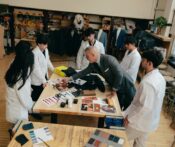
Does the Future of Italian Tailoring Lie in ... Chicago? Naples-based luxury label Kiton thinks so, which is why it’s established a pioneering new course for Chicago Waldorf School high schoolers.
May 19, 2025
As the American director of wholesale made-to-measure, Victor de Leon, lives in the city. His children attend Chicago Waldorf School. One day, sitting in on a second-grade handwork class—Waldorf schools often eschew a traditional curriculum in favor of a holistic cocktail of intellectual, creative, and practical skills—he was struck with an idea. “I was watching seven-year-olds sewing and weaving and knitting socks and gloves and hats,” he says. “And they were doing it with such ease, like little tailors. It made me think.” More »

Trust in the Toddler
May 12, 2025
A simple pop-up puppet can be a thing of wonder for a toddler. One minute it is looking at you, the next moment it is gone! The motif of being present and hiding away has a strong connection to self, as the words from a traditional children’s song indicate: Where is Thumpkin? / Here I am! The growing sense of self in the young toddler continues to enthrall parents, teachers, and scientists as we strive to understand more about this critical period in our children’s lives. We know from brain science that the first three years of life are a time of incredible learning, and critical for a foundation for well-being and success. Alison Gopnik speaks of this time as the “R&D” of humanity – when young children are blessed with possibility and plasticity. This is a window of opportunity that has unique characteristics – the primary one being that the brain has no previous learning or knowledge. Therefore, the patterns and neuropathways that are formed can serve as a foundation for future learning. Rudolf Steiner speaks about this period as a time of opportunity and great wisdom. At this time, the young child learns not through instinct but through a higher, expanded, and “wiser” self. More »
 Recent Jobs
View more jobs »
 Newsletter Archive
 Join the Mailing List!
Stay Connected…
Each week receive the Waldorf News Weekly Update, full of news, events, and more. Keep abreast of what's happening with Waldorf education.
 Add a Job Listing


 RSS Feeds