Waldorf News
What Happens When We Replace Images With Words?
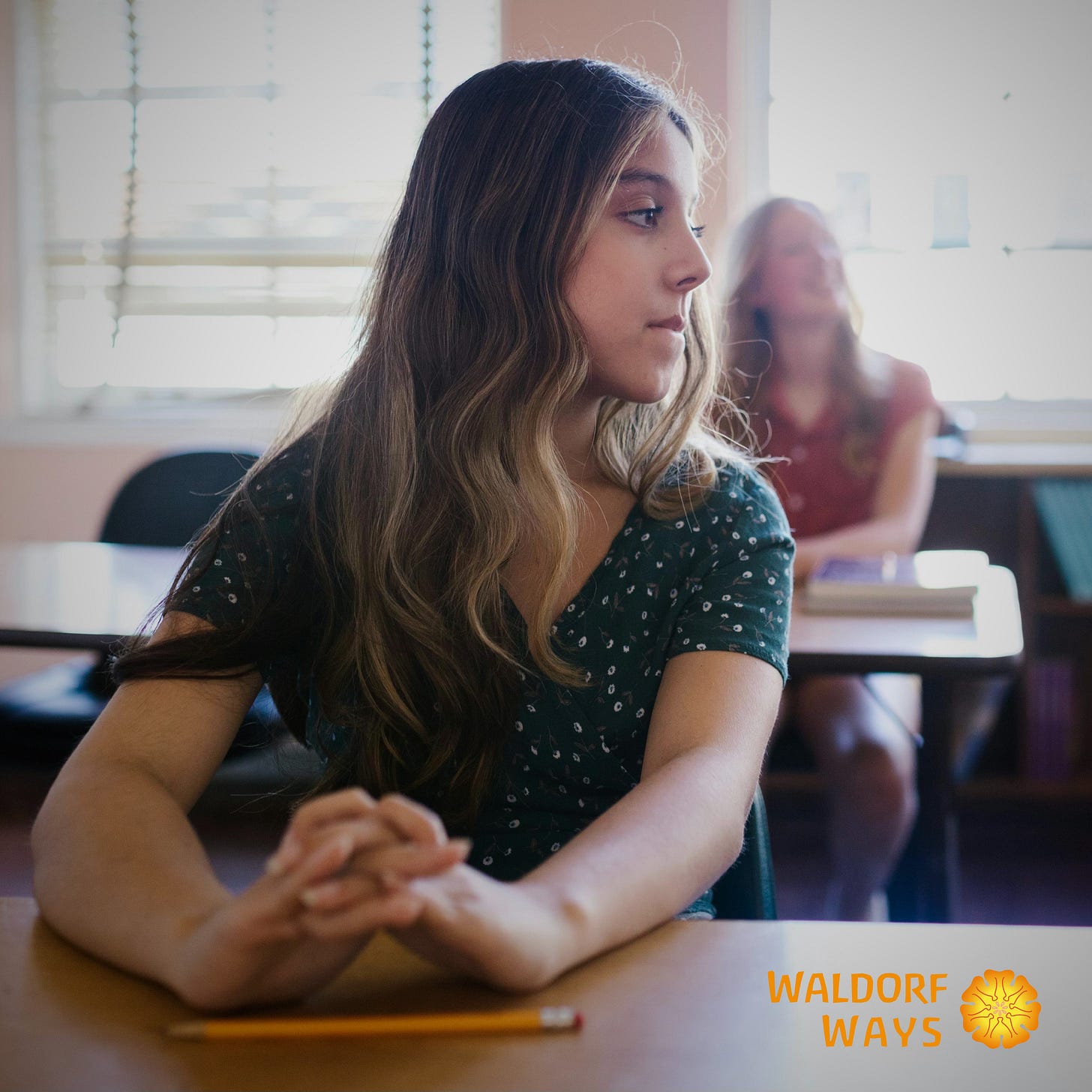
It feels like good teaching. But the children are not responding.
By Donovan Gay
Waldorf Ways
“Stand straight as a spear, Class 1”
Just that, nothing else. Then I wait.
I have used this line since I first started teaching. It is simple, clear and the image is taken on by the children instantly. Within moments each child is standing straight and still.
This is the power of an image.
However, there is an ever increasing trend happening in Waldorf classrooms across the globe. The image is being replaced with a story.
I have seen it in classrooms, heard it discussed by teachers and seen posts on social media asking for the perfect story for some activity or action the teacher needs.
What sounds more Waldorf than a good story, a creative verbal imagination to engage the children and tap into their core learning capacity?
But when we go into the classrooms something feels off. It feels nice but it’s not achieving what is needed.
In the classroom there is often a story for everything now. Not long or in depth but a small story is used for a wide variety of activities. A story for line up, a story for sitting still, a story for painting, a story for many activities.
Teachers collect and keep stories in various places from their training courses, colleagues and online. I have seen some beautifully crafted books in meticulous handwriting documenting stories for almost every conceivable activity in class.
On the whole these stories are often beautifully crafted, imaginative and truly hold the children’s imagination. I love a story as much as any other teacher. But do we need so many? Has something been lost along the way?
Imagination is a core principle in the class teacher years. We engage the child’s imagination as a vehicle for all the learning.
Imagination imbues much of the work we do as class teachers. It’s well established that Waldorf education is steeped in imagination.
And from that the power of storytelling is paramount in the early grades and even right up into the high school.
It’s from this that we can get lost when we think everything must have a story. Every bit of new content, all classroom activities, movement etc.
And when you have good stories it feels enriching and engaging for the children and seeing them drift into the imaginative realm of the story, it just feels right.
The problem with that is the children are given too many images, over several stories through the day and then possibly other stories the next day and so on.
This begins to remove any clarity in what is being presented and any precision we hope to achieve for activities is lost.
Images overlap and get mixed with others and the children struggle to hold on to them. After a week or two of an excess of stories the children have no clear picture and as one image blurs into another the teacher is left with children who are not responding to the images provided.
As this quiet inner chaos grows the teacher goes and tries to find a better story and so the pattern just continues. Children can be perceived as not listening, misbehaving etc as they do not get the clarity the teacher wants to achieve from the image.
We often as teachers speak about the dangers of technology and the sensory overload the children are exposed to but at the same time we can be doing the same thing with too many stories. Image overload. No clarity.
This image overload leads to confusion and the purpose of its use is lost. Clearly what sounds lovely and wonderful to our adult intellect does not have the same response in the children.
But in contrast with that if we are economical and use images not stories we can maintain clarity and engage the children easily.
An image in this context is something that is very simple, direct and can be conveyed in as few words as possible.
When we use our imaginations as teachers and apply them to the activities we can easily find little one liners that convey clear illustration for the children almost instantaneously.
Like the example I started this post with, “Stand straight as a spear.” This gives the children a clear pictorial image of what I expect from them when they stand and immediately, they are all stood straight and still.
Another example I have used is when we are painting and I want to avoid the children pushing their paint brushes too hard into the paper, damaging the surface and creating balls, I tell them that the paint brush may only gently touch the page using the image of “the brush must tickle the page”.
This example has worked every time I have used it without fail. The children immediately know from that image that they must only touch the surface of the paper gently.
Replacing these types of images with stories is really just a misunderstanding of how the imagination is used in the Waldorf classroom, and then over time this becomes the norm.
These types of images are not about quantity but about precision and quality.
In this case more is not better at all but a burden on the children. It weakens their engagement and then all the situations that follow that.
When we engage our imaginations and look for a good precise image to use in a situation we can come up with endless varieties.
Additionally, when we engage our imaginations in this way we bring ourselves into the work we do, we use images that are particular to us and therefore offer a more individualized and personal approach which the children will engage in more strongly than something you read out of a book or webpage.
Stories look and feel very Waldorf but for most of what we do in the classroom we only need good clear images.
Story most definitely has a place in our classroom to be the vehicle of new content and the images we need for that work, the children do not need a story for every activity they do.
So, take a moment when doing your planning and give yourself over to imagination and find the simple clear image you need to help the children fulfil tasks easily. Keep them concise, pictorial and sharp. Don’t let them get lost in a long story with characters etc. Keep it clean.
“When everything becomes a story, the image loses its power.”
Donovan Gay has worked in Waldorf education for more than thirty years, teaching in the UK, South Africa and now online. He writes Waldorf Ways, where he reflects on child development, classroom practice and the deeper intentions that lie behind Waldorf education. He continues to teach because children remain his greatest teachers.
 Recent Jobs
 Newsletter Archive
 Join the Mailing List!
 Add a Job Listing

 RSS Feeds