Waldorf News
Head, Heart, and Hand
A Reflection on Waldorf Education and the Three-Fold Human Being
Thinking · Feeling · Willing — and the art of living whole
By Hans Tholken
Marinela Holistic Education, Barbados
“Everything starts in the mind. A thought becomes a word. A word becomes an action. An action, repeated, becomes a habit. And a habit, sustained, becomes your destiny. Guard the beginning.”
Foreword
Every human being thinks. Every human being feels. Every human being acts. These are not three separate faculties accidentally housed in one body. They are three dimensions of a single life, as inseparable as length, width, and depth.
Waldorf education builds its entire method on this insight that educating a child means cultivating all three capacities in the right order, at the right time, and through the right activities.
The image is ancient. The medieval thinker spoke of ratio, affectus, and voluntas. Rudolf Steiner, the founder of the first Waldorf School in 1919, named them Thinking, Feeling, and Willing and placed them at the center of Waldorf Education.
But the insight extends far beyond the classroom. It is a map of the human soul itself.
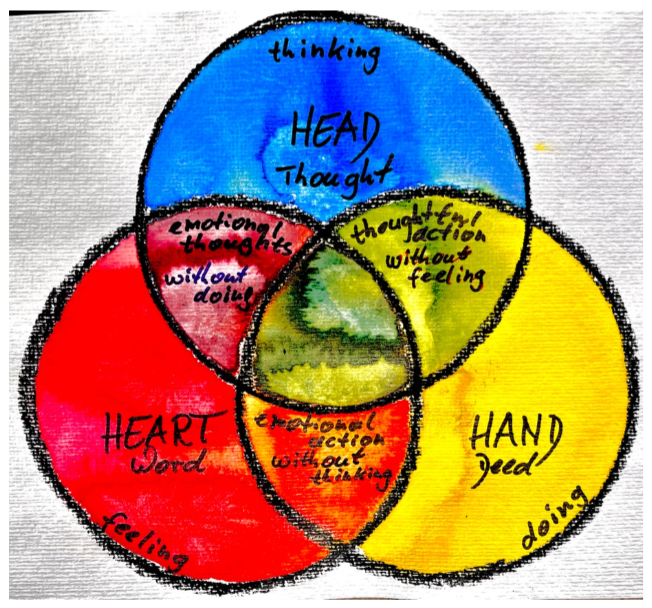
The Three Capacities
Thought — Head
This is the capacity to perceive, abstract, analyze, and form concepts. It is the domain of clarity, logic, and inner light, yet it becomes cold when isolated from the other two capacities.
Word — Heart
This is the capacity to feel, not merely emotion but the soul’s resonance with beauty, suffering, justice, and love. It is the bridge between thought and deed.
Deed — Hand
This is the capacity to will, to act, and to bring something into being in the world. It is the realm of initiative, craft, and the courage to begin.
Together, they form what Waldorf calls the threefold human being. They correspond to what we might call the life of cognition, the life of soul, and the life of will.
None of them stands alone without distortion. Thinking without feeling becomes ideology. Feeling without thought becomes sentimentality. A will that neither thinks nor feels becomes violent.
When One Is Absent
The three capacities ideally remain in balance, but life, temperament, training, and vocation all pull people toward specific combinations. When one capacity is consistently underdeveloped, a characteristic human type emerges. Understanding these types is not about judgment. It is about recognition and, ultimately, about invitation.
Head and Hand — without Heart
Efficient, Rational, Calculating, Precise — Cold, Detached
This person thinks clearly and acts decisively, but without the warmth of feeling to guide them, their competence can become dangerous. They optimize systems without asking who the system serves.
They solve problems without feeling the weight of what is at stake. The world becomes a mechanism to operate rather than a community to belong to.
This type appears among data scientists, systems engineers, military strategists, corporate managers, and certain types of surgeons wherever technical excellence is rewarded, and emotional attunement is neither required nor actively suppressed.
Consider the organization of a bank. The clerk who receives a loan application from a customer does not decide whether it is approved.
A different employee, who evaluates only the bare numbers, is deliberately kept from forming any personal impression of the customer so that feelings are excluded from the process.
Head and Heart — without Hand
Idealistic, Empathetic, Visionary, Reflective — Passive, Indecisive
This person understands the world deeply and cares about it profoundly, yet cannot seem to act. They produce beautiful plans that remain in notebooks. They feel the injustice of the world but freeze at the moment of intervention. Thinking and feeling circle each other endlessly, without finding a foothold. The result is insight without consequence.
This type appears among philosophers, poets, ethicists, contemplative theologians, certain therapists, and the priest who prays for a better world but does not descend into its dust to change it. Yet intercession is real work, and pure thinking and deep contemplation are themselves deeds that act upon the world without hands.
Heart and Hand — without Head
Passionate, Spontaneous, Devoted, Generous — Impulsive, Restless
This person overflows with energy and genuine care, but without the guidance of thought, warmth becomes intensity, and intensity becomes harm.
They rush to help before they understand the situation. They act on feeling rather than on wisdom. Their kindness smothers, and their courage cannot distinguish between a righteous cause and a dangerous one.
This type appears among certain activists, impulsive caregivers, artists who create without craft, social workers without boundaries, and the passionate amateur who means well but fails to think things through.
The Mode That a Role Demands
One of the deepest insights the Head, Heart, and Hand model offers is not merely about who we are but about what situations ask of us. Every role, every profession, and every institutional context calls for a particular register, a specific weighting of the three capacities.
Here lies a crucial distinction, namely that the absence of a capacity in a role is not always a deficiency. Sometimes it is the very condition for the role’s effectiveness.
The soldier who allows feeling to enter the moment of combat may hesitate, and that hesitation costs lives. The drill, the hierarchy, and the uniform are technologies that temporarily suspend the heart so the hand can act with precision and the head can follow orders without the noise of grief.
The hierarchy provides the thinking, because the officer thinks and the soldier acts. This is Head and Hand, with Heart suppressed by design.
Consider the range of roles that require radically different weightings.
The surgeon in the operating room works with Head and Hand simultaneously, with precision, knowledge, and skilled execution, while Heart is deliberately bracketed because they cannot afford to be moved by the particular human being on the table if the scalpel is to remain steady.
The emergency responder operates on the same principle. Trained protocol replaces individual judgment; feeling is suspended and processed only afterward, and the hand acts with a speed that conscious feeling would only interrupt.
The judge in court goes further still. Feeling is not merely bracketed but formally excluded because the law’s authority rests entirely on impartiality. The ruling is an act of Head and Hand, and Heart must wait outside the courtroom door. Yet even a judge retains the freedom to temper conviction with mercy.
At the opposite extreme sits the therapist, for whom Heart is the primary instrument. Attunement, resonance, and the capacity to feel with, rather than merely about, the client constitute the entire method. The Hand is restrained, and the Head serves feeling rather than directing it. Yet a clear mind remains essential so the therapist can provide appropriate support and take necessary action.
The artist or craftsperson lives in Heart and Hand together. Feeling supplies the impulse; the hand realizes it in material, and thinking enters only as the servant of the vision, never as its master.
The teenager and the priest perhaps represent the two most revealing cases. By nature and developmental necessity, the adolescent lives primarily in the mode of the Heart. They see the shortcomings not only of their parents and teachers but of the whole world.
They suffer with the underprivileged yet have found neither the tools nor the place to change anything. Feeling is everything, including identity, belonging, injustice, beauty, first love, and first loss.
The Head is awakening but is not yet sovereign. The Hand is restless and hungry for a cause, but has not yet found the form its energy belongs to. This is not a deficiency. It is a developmental season.
The contemplative priest stands at a different point along the same axis. Head and Heart are both present, sometimes profoundly so, but the Hand is consecrated rather than worldly.
Prayer, intercession, and liturgy are genuine acts of will, directed inward and upward rather than outward toward social transformation. The priest who prays for a better world has not failed. They have chosen a particular mode, and whether that mode is sufficient is a question every contemplative tradition must answer for itself.
How Waldorf Cultivates the Whole
Waldorf education is a developmental anthropology, a carefully sequenced cultivation of all three capacities in the order in which they naturally ripen in the child.
The foundational principle is that no capacity should be called upon before its time. Calling upon thinking before feeling is established, or action before the will has been lovingly formed, distorts rather than educates.
Ages 0 to 7 — The Hand, where Willing is primary
Children learn by imitation. They engage in purposeful physical work, such as baking, crafting, and sweeping. There is no formal instruction because the will is formed through action. Fairy tales quietly nourish the feeling life. Rhythm and rituals provide security.
Ages 7 to 14 — The Heart, where Feeling is primary
Art is woven into every subject. One teacher accompanies the class for eight years so that learning happens in relationship. History is taught as a story, and botany as wonder. Main lesson blocks progress from the artistic first to the conceptual last. Handwork, music, and eurythmy are present throughout.
Ages 14 to 21 — The Head, where Thinking is primary
Abstract thought is now invited rather than imposed. Students engage in independent research and debate. The Class 12 project unites head, heart, and hand in a single act. Philosophy, ethics, and judgment are central. The thinking that emerges is warm because feeling preceded it.
The Waldorf Main Lesson
At the heart of every Waldorf school day is the Main Lesson, a two-hour stretch each morning that forms the class’s primary academic and artistic work.
It is not a single subject crammed into two hours. It is a living arc, carefully shaped to honor the full rhythm of the child’s learning. It has three parts, each essential and irreplaceable, each addressing all three modes: Head, Heart, and Hand.
The Morning Circle — The Rhythmical Part
The lesson opens with rhythm. Before the thinking mind is asked to work, the whole child must awaken through movement, breath, music, and beauty.
Rudolf Steiner’s insight was simple and profound: rhythm replaces strength. The child who has moved, sung, and spoken with their class is different from the one who just walked in from the street. They are ready.
The Morning Circle in the lower grades is not merely a warm-up. It is the seat of will formation in the lower grades.
It typically includes the morning verse, spoken in unison as a threshold ritual between home and school. It includes seasonal songs in pentatonic tuning in the first grade that awaken the feeling life. It includes recitation of block-related verses and poems that cultivate memory and language through joyful repetition.
It includes clapping patterns, stepping games, and rhythm exercises that are cross-lateral movements, integrating the left and right hemispheres. It includes beanbag toss and catch, rope jumping, and ball rolling, all of which build physical confidence and spatial awareness.
It includes circle walks, spiral walks, and animal walks, which are purposeful movements through space. It includes finger games and hand exercises that strengthen the small muscles that guide the pencil and crayon and prepare the fingers for the instruments to come, such as the pentatonic flute, the recorder, and string instruments.
The Morning Circle lasts about twenty to thirty minutes. It ends with a clear, settled transition, during which the children take their places, the room quiets, and the lesson turns inward.
Book Work — The Academic Learning
With bodies awake and souls attuned, the children are now ready to engage with the lesson’s intellectual content. This is the longest part of the Main Lesson, typically lasting fifty to sixty minutes, and it carries the block’s primary academic work.
The structure of Book Work follows Steiner’s principle of memory through the night. New material is never introduced and assessed on the same day.
Instead, the lesson opens with a review of the previous day’s content, material that has had a night to settle, consolidate, and deepen during sleep. Children are often surprised by what they now understand, having found it elusive the evening before.
This is not a mere repetition of the previous day’s material but can be deepened through a drawing, a watercolor, a clay work, or a role play. Even in the academic part, doing through the Hand has its place.
New content is then introduced, always through a living image, such as a story, a chalkboard drawing, a demonstration, or a spoken narrative. The child receives it with wonder and full sensory attention. Nothing is rushed because the image must breathe. This works on the child’s feelings through the Heart.
Children then work individually and record the content in their Main Lesson Book, a large unlined book that serves as both an artistic portfolio and a personal scholarship. Writing, drawing, painting, and calculating are all present, and each page is composed with form, color, and intention.
The Main Lesson Book is not a workbook. It is a work of art. Over the course of a school year, it becomes a lasting record of the child’s growing mind and hand. The hands and the heart must be engaged before the abstract mind is invited in.
What is perhaps most remarkable about Book Work is that even this most overtly academic portion of the school day refuses to be purely intellectual.
All three capacities are present and at work.
The Head is engaged when the child wrestles with new concepts, forms understanding, and brings order to what they have received.
The Heart is engaged when that content arrives as an image, a story, and a wonder rather than as dry information.
The Hand is engaged when the child draws, paints, writes, and crafts each page of their Main Lesson Book into something made, something that did not exist before they sat down.
Even in its most cognitive moment, Waldorf education will not abandon the whole child. The threefold human being is never set aside but is simply asked, in different proportions, to show up fully.
Story Time — The Closing
The Main Lesson closes as it opened, not with facts but with images.
The teacher tells or reads a story, and the children listen in stillness. Whatever the lesson’s academic content, the story does not explain or summarize. It gives the children something that lives, an image that will continue to work in them through the day and into sleep.
The story content aligns precisely with the child’s developmental stage.
In Class 1, the teacher tells Grimm’s Fairy Tales, which present archetypal images of transformation, goodness, and wholeness that speak directly to the young child’s soul life without explanation.
In Class 2, the teacher tells Fables and Saints’ Lives, which convey animal wisdom and the deeds of great human beings, bridging the child toward the complexity of the moral world.
In Class 3, the teacher tells Old Testament and Creation Stories, which recount humanity’s long journey, a reality the child first feels as they begin to experience their own individuality.
In Class 4, the teacher tells Norse Mythology, and the drama of Ragnarök mirrors the inner experience of the nine-year change, the dawning awareness of mortality and separateness.
In Class 5, the teacher tells stories of Ancient Civilizations, including India, Persia, Mesopotamia, Egypt, and Greece, each a portrait of humanity at a different stage of consciousness, so the child meets the great arc of human becoming and finds themselves somewhere within it.
In Class 6, the teacher tells stories of Ancient Rome and the Medieval World, including the rise of law, empire, and the Church, and biography enters as a central mode, so the lives of Caesar, Augustine, and the great medieval figures show how individual will can shape the course of history.
In Class 7, the teacher tells stories of the Renaissance and the Age of Exploration, including the awakening of the individual, the voyages into the unknown, and the lives of Leonardo, Copernicus, and the explorers, which mirror the adolescent’s own dawning sense of self and boundless horizon.
In Class 8, the teacher tells stories of the Modern World and Revolution, including the French Revolution, the American Revolution, and the Industrial Revolution, as well as the biographies of those who broke with the old order and remade the world. They meet the adolescent exactly where they stand, on the threshold of their own power to act.
The teacher may tell the story from memory, and this is no small matter. The living quality of the spoken word, without the mediation of a page, creates a direct bond between teller and listener. The image enters the child unmediated. No explanation follows because the story is trusted to do its own work.
Methods Across All Phases
Eurythmy — All Three Modes
Eurythmy is visible speech and visible music, in which the body moves in response to language and tone. Thinking, feeling, and willing are integrated simultaneously. The student understands with the whole organism rather than merely with the mind.
Art as Method, Not Subject — Heart and Hand
Children paint before they write. They model before they define. Grammar is taught through drama, and fractions through movement. Art is the medium through which all knowledge is received, so that knowing is always also feeling and doing.
A telling example is the multiplication table. Before a child is ever asked to calculate with it consciously, they have already lived inside it by singing it, clapping its rhythms, and walking its patterns across the floor in purposeful steps.
The multiplication table enters first through the body and the voice, through pleasure and pulse, long before it becomes an object of abstract thought. By the time the Head is invited to work with it, the Heart and Hand already know it by heart.
This is not a shortcut. It is the Waldorf sequence in miniature, in which feeling and doing prepare the ground so that thinking, when it arrives, finds the knowledge already alive and waiting.
Handwork and Crafts — Hand
Knitting, woodwork, sewing, clay, and beeswax modeling and weaving begin in the first class and continue throughout. These activities develop fine motor skills, patience, spatial thinking, and the irreplaceable experience of bringing something into being through sustained effort and will.
The Class Teacher Relationship — Heart
One teacher accompanies the same class for eight years. This sustained relationship of genuine care is, in itself, an education in loyalty, in being truly known, and in the discovery that learning is inseparable from love.
No Grades in the Early Years — Head Assessment through narrative year-end reports preserves the child’s natural wonder.
When external judgment is withheld, the inner motivation of curiosity remains the engine of learning. Thinking that grows from wonder is alive, whereas thinking that grows from fear of failure is dead.
The Whole Person in Different Modes
Here is the deepest subtlety the model offers, and the one most easily missed. It is tempting to think the goal is a person who is permanently and equally head, heart, and hand, a constant equilibrium in which all three are weighed in every moment. But this is not the vision.
A person of genuine integrity, someone who has fully cultivated all three capacities, is precisely the one who can move freely between modes without losing themselves. They are not always balanced. They are always whole.
The same person who must think coldly in the operating theater will weep with their child at night. The same judge who excludes feeling from the bench will feel deeply when praying. The same artist who works in passion must think precisely when reading a contract. Wholeness is not equilibrium. It is freedom.
Consider a teacher in the classroom while teaching a difficult concept: they think with precision through the Head. In the same lesson, they feel the class’s mood, notice the child who is struggling, and adjust their tone through the Heart.
They then act by moving to that child’s desk, modifying the exercise, and bringing something new into being through the Hand. All three are present, fluidly, within a single hour.
That evening, while reading poetry alone, they may rest almost entirely in Heart. The following weekend, while repairing something at home, they work in Hand, absorbed in the material and with the mind quiet.
On a long walk, they think alone, planning and weighing in the Head, without the pressure of feeling or action. They move between modes as life requires, without rigidity.
The person who lacks one capacity cannot make this movement. They are locked into the two they have. The person who has all three is genuinely free, meaning they are free to be fully present in whatever mode the moment calls for and free to return.
This is also why Waldorf education is ultimately not about producing a certain type of person.
It is about producing a person who is not locked into a type. The well-educated human being is the one who can, when required, be judge and priest, thinker and craftsperson, visionary and servant, not all at once, but each in their season.
The Person of Integrity
A person who has cultivated Head, Heart, and Hand in their fullness is marked not by constant balance but by the freedom to move among modes.
They think with warmth because their thinking grew out of a life of feeling. They feel with clarity because their feelings were never left undisciplined. They act with both wisdom and compassion because the hand was trained alongside the other two.
They can suppress feelings when the moment demands precision. They can step back from action when the moment demands reflection. They can let go of analysis when the moment demands simply being present and caring.
Not only Waldorf Education but the world also names the qualities of such a person as integrated, reflective, compassionate, creative, courageous, discerning, purposeful, and grounded.
Yet beneath all these words lies a word that is even simpler.
The person who has all three capacities and can move freely among them is simply free.
Waldorf education ultimately seeks to cultivate that inner freedom, the freedom of the soul.
“Receive the children in reverence,
Educate them in love,
Release them in freedom.”
-Rudolf Steiner
Hans Tholken, a Master Organ Builder and Waldorf teacher, is originally from southern Germany. He also pursued BAs in Art Education and Education. This foundation led to a significant career as a Waldorf Arts and Crafts, Music, and Class teacher, where he also served as Faculty Chair. Hans has also shared his expertise at Waldorf teacher trainings across continents. His teaching experience spans numerous countries such as Germany, Switzerland, Sweden, Hawaii, Canada, Guatemala, and Costa Rica. Hans is now based in Barbados.
 Recent Jobs
 Newsletter Archive
 Join the Mailing List!
 Add a Job Listing

 RSS Feeds