Waldorf News
Marin Waldorf School Launches Reforestation and Restoration Project
by PJ Bremier
Just west of Marinwood Park and a short walk from Lucas Valley Road in Terra Linda, the Marin Waldorf School occupies 10 acres of land leased from the Miller Creek School District.
Today some of that land, mostly covered in weeds and grasses, has been replaced with native plants and now buzzes with pollinators in a landscape supported by students who learn to care for their piece of Earth.
In February, the school launched a three-year reforestation and restoration project in partnership with Point Blue Conservation Science, formerly known as the Point Reyes Bird Observatory, and its STRAW (Students and Teachers Restoring a Watershed) program.
The goal was to help heal the land, support pollinators and teach students that climate action begins in your own backyard.
“We know that native plants need less water, promote soil health and lead to a more balanced ecosystem, all important steps to mitigating the effects of climate change,” said Megan Neale, director of the Marin Waldorf School.

Native plants and pollinator-friendly shrubs have been planted at the Marin Waldorf School. (Courtesy of the Marin Waldorf School)
Founded in 1972 by three mothers in a Fairfax home, Marin Waldorf School now educates around 160 students, from preschool through eighth grade, with a founding mission rooted in the holistic principles of Waldorf education: nurturing the whole child through hands-on, interdisciplinary learning and a deep connection to the natural world.
The Marin Waldorf School launched a three-year reforestation and restoration project in partnership with Point Blue Conservation Science and its STRAW program. (Courtesy of Marin Waldorf School)
“As a Waldorf school, we strive to see and honor each child for who they are, recognizing their unique gifts, dignity and creative potential,” she said.
“We encourage children to connect with Earth and with each other, nourished by a deep sense of self and a responsibility toward others. Seeing and honoring each child for who they are is at the heart of what we do.”
That ethos made the partnership with Point Blue a natural fit. The idea to work with the conservation organization began with Waldorf teacher and environmental activist Tracy Harrington.
Through her, the school connected with the STRAW program, which empowers students, teachers and communities to restore native ecosystems — one plant at a time.
The project officially began last school year with students and teachers planting more than 200 native, pollinator-friendly plants across the western edge of the campus, which was previously filled with weeds and wild grasses.
They even installed a new honeybee hive near the third-grade garden, where students spend the year studying agriculture and food systems. (There are three teaching gardens on campus, including a large biodynamic garden that all grades use.)
For four days, teachers, staff and students worked together to install those plants alongside the Point Blue team.
In the months that followed, students continued to water and care for the plantings, supported by the Point Blue team.
And this fall, the collaboration continues, as Point Blue returns to campus to teach environmental restoration lessons to the middle school students, tying hands-on learning to broader ecological principles.
This isn’t the school’s first foray into ecological restoration. Marin Waldorf’s active site committee has spent years replacing traditional landscaping with native plant species.
Based on the school’s previous landscape work, Neale knows that its work with Point Blue/STRAW will have an immediate positive effect on the local ecosystem.
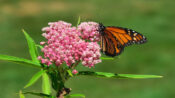
In August 2019, parent volunteers helped replant the central courtyard, now known as the Peace Garden, with pollinator-friendly shrubs and flowers, including milkweed to support the struggling monarch butterfly population.
“About a year later, multitudes of monarch butterflies were everywhere on campus, and dozens of monarch caterpillars were found clinging to the leaves of the milkweed shrubs,” she said.
“It was incredibly moving to see these endangered insects so quickly find a home with us. Being able to take that work further and reach more species is our goal.”
Students play a direct role in campus stewardship, from composting and brush clearing to managing the school’s recycling program. But the Point Blue partnership, along with its grant, allows the school to take it further, as it can introduce Point Blue’s scientific expertise on native plant restoration and wildlife corridors through hands-on education.
Projects like these don’t just help pollinators and improve soil health, they also give students a concrete sense of agency in Earth stewardship.
By planting native species, conserving water and building habitat corridors, students learn that restoring even a small patch of land can have ripple effects far beyond the school gates.
The restoration effort will unfold over the next three years, each one combining education with action. So far, students have studied pollinators, water cycles, plant biology and the role of native species in sustainable ecosystems.
“We know that taking care of the Earth is slow and steady work and that it takes all of us,” Neale said.
“We aren’t making big promises in terms of what our campus alone can do. Our campus is one link in the chain, and our students understand that, too.”
Perhaps these small but mighty changes have inspired a new generation of Earth stewards.
from the Marin Independent Journal
 Recent Jobs
 Newsletter Archive
 Join the Mailing List!
 Add a Job Listing

 RSS Feeds