 Bay Area Teacher Training
 Immersive Academics and Arts
 Transforming Voices Worldwide
 Everything a Teacher Needs
 Train to Teach in Seattle
 Middle School Science With Roberto Trostli
 Association for a Healing Education
 Grade-specific web courses for teachers
 Preparing Teachers for 2024-25 Grades 1-8
 The Journey is Everything
 Waldorf-inspired Homeschool Curriculum
 Full-Time Teacher Education
 Jamie York Books, Resources, Workshops
 Space speaks. Its language is movement.
 Waldorf Training in Australia
 Flexible preparation for your new grade
 Grade Level Training in Southern California
 Caring for All Stages of Life
 Roadmap to Literacy Books & Courses
 Waldorf Stories for Everyone
 Great books for Waldorf Teachers & Families
 Quality Education in the Heartland
 ~ Ensoul Your World With Color ~
 Summer Programs - Culminating Class Trips
 Bringing Love to Learning for a Lifetime
 Training in Traumatology & Artistic Therapies
- Training in Traumatology & Artistic Therapies
Would you like to become a sponsor?
Waldorf News
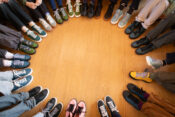
Michael Hall Shoes
January 29, 2024
Rudolf Steiner said, “If you can make your own shoes, you can do anything.” Last week Class 8b were very fortunate to take part in a shoe-making workshop. The cobbler guided them through the process of first cutting out the leather uppers from a pattern before making stitching holes and lacing holes with specialist leather tools. The children then had the option to impress additional details on the leather and fix metal eyelets on the lacing holes. Finally, they hand sewed the leather uppers to the rubber soles. A pair of new sneakers was indeed the perfect project for a young teenager! More »
From Greed to Care
January 22, 2024
You could have had a perfect career in physics, philosophy, economy, or academia, but you didn’t. Why not? I gave up my academic path even though I was totally passionate about quantum theory. I chose to dedicate my life to ecological work and activism because I realized that, yes, I would have amazing mental challenges—I could have been busy with quantum puzzles for 100 years—but it would have been an indulgence. Small studies were actually saving valleys, rivers, and forests. I realized that my service must go to the earth and to people. More »
Children’s Play and Virtual Reality
November 14, 2023
When I was a child I had never heard of the term ‘virtual reality’. Back then virtual reality wasn’t ‘a thing’, those two words hadn’t been married together for common usage even though the first flight simulator was operational in 1929. Virtual reality as a ‘thing’ proliferated in the second half of the twentieth century in association with the exponential developments in the computing technology sector. When we think of virtual reality (VR), many of us think of gaming where players ‘play’ in an immersive life-like simulated world. While this sector of VR is set to expand as the demand for ‘real-life like’ entertainment increases, VR is currently employed in areas as diverse as psychology, medicine, education and manufacturing. Margaret Fuller reminds us, “The mind is a not a highway but a temple. The door should not be carelessly left open.” Never having played VR games myself, I can’t say first hand what could possibly enter through the temple door into the mind of the player. Instead, I have to rely on the experience of others. More »
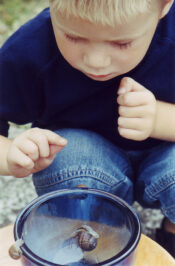
Wonder Fuels a Love Affair: Keeping the wonder alive as our children develop their love affair with Life
November 4, 2023
Here is a paradox worth exploring if we are to enjoy this planet and grow in our sense of belonging: it is all ordinary, and at the same time, it is all extraordinary. I know this paradox applies to information technology, to numeracy and to literacy. It has to, simply because it is all ordinary and extraordinary. However, I want to go back to basics. It’s logical that if you don’t have a good grounding in the basics, what follows can be very precarious. Basically, we are a part of the biosphere of this planet. As far as we know, we are the one species which, as a part of the creation, can reflect on and wonder at the creative process, that is, the Life on this planet. For adults, it is in the reflection and the wondering that the extraordinary is revealed. More »
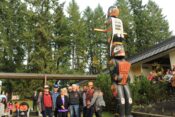
Totem pole at the HUB stands as a symbol of community: Sunrise Waldorf School hosted Scow and the totem pole for the winter until the raising
October 30, 2023
A gathering at The HUB at Cowichan Station on Sunday brought community members together to celebrate the work of Kwakwa̱ka̱ʼwakw artist Rupert Scow and raise a totem pole that he — with the support of many others — built and gifted to the community. Dozens of people of all ages and backgrounds arrived at the HUB on Sunday morning and eagerly waited outside to witness the raising of the totem pole. Forecasted rain held off during the gathering, and the sun made appearances throughout the day. Children ran and played, periodically asking questions about the totem pole which was seen leaning backwards with ropes tied around it to help with the raising. Many adults in the crowd spoke fondly of Scow, who has been working on the totem pole at the HUB and nearby Sunrise Waldorf School for the past year. More »
 Recent Jobs
View more jobs »
 Newsletter Archive
 Join the Mailing List!
Stay Connected…
Each week receive the Waldorf News Weekly Update, full of news, events, and more. Keep abreast of what's happening with Waldorf education.
 Add a Job Listing


 RSS Feeds